
Dealing with Misrepresentation in Google Ads: A Practical Guide for Advertisers
If your ads have been disapproved or your account has been suspended due to misrepresentation, the impact can be immediate and commercially serious. That’s because, for many SMEs, Google Ads is a primary driver of leads and online revenue.
When that channel is restricted, the pipeline slows down quickly and internal pressure builds just as fast. What makes the situation more difficult is that Google does not provide detailed explanations, leaving businesses unsure of what actually went wrong.
Misrepresentation is one of the most strictly enforced areas of Google Ads policy, and it applies far more broadly than most businesses expect.
It is not solely reserved for fraudulent operators or obvious scams. Legitimate businesses can trigger it through unclear wording, missing disclaimers, exaggerated claims or inconsistencies between ads and landing pages.
Understanding how Google interprets this policy is critical if you want to protect your account or successfully appeal a suspension.
Luckily, we’ve put together this guide to help with exactly that!
Resources: The Misrpresentation Checklists 📝
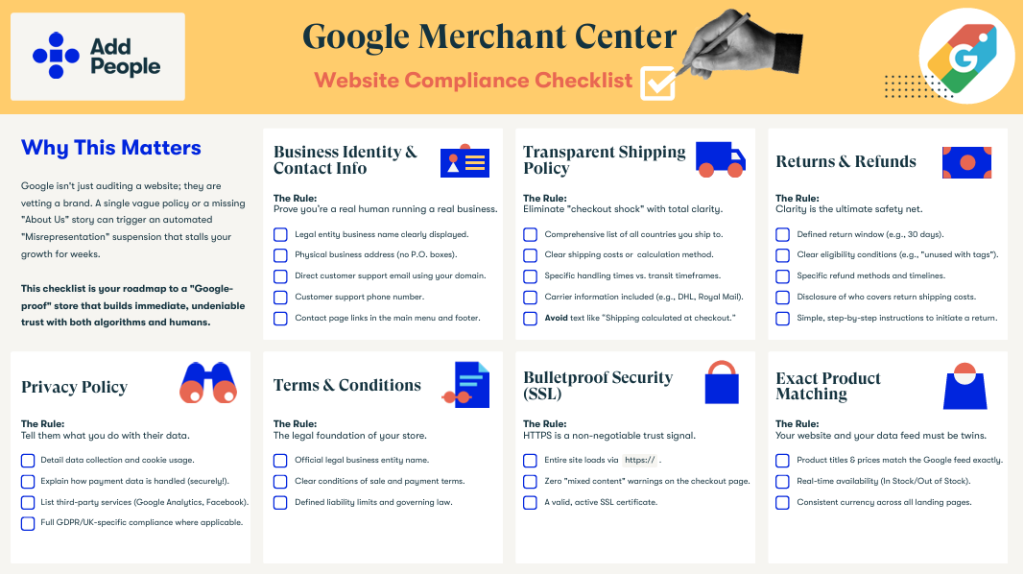
To help you navigate the waters of misrepresentation, we’ve put together two separate checklist resources. The first is an interactive document that you can update yourself, and the second is a more visual look at what you need to do.
Both are designed by our in-house experts, free, actionable and available below!
Click here for the interactive document!
Click here for the visual document!
What Is Google’s Misrepresentation Policy?
Google’s Misrepresentation Policy forms part of the wider Google Ads advertising framework. Its purpose is to prevent advertisers from misleading users through inaccurate, deceptive or incomplete information at any stage of the advertising journey.
Importantly, this does not just apply to the ad headline or description. Google assesses the full user experience, from the initial click through to the landing page, checkout process and overall business transparency.
The policy is designed to:
- Protect users from scams and harmful practices
- Ensure transparency in advertising
- Maintain trust in the Google Ads ecosystem
Because user trust is central to Google’s platform, enforcement is often strict and preventative. If there is any reasonable concern that users could be misled, Google may act before complaints or damage occur.
What Can Happen If You Breach It?
If you have been found to fall foul of the policy, Google will suspend your merchant centre account, meaning that you are no longer able to run shopping ads. In more serious cases Google will also suspend your ads account, stopping you from running ads altogether, therefore it is imperative that your website is compliant.
Reinstatement is possible, but it is rarely straightforward. Google expects a detailed appeal that demonstrates you have identified the root cause, corrected the issue and brought the account fully into compliance.
Appeals that lack specificity or fail to show clear corrective action are often rejected.
What Counts as Misrepresentation?
One of the main challenges for SMEs is that misrepresentation is not limited to deliberate dishonesty. Google’s assessment is based on the potential to mislead, not on intent.
That means marketing language that feels commercially persuasive can still be flagged if it overpromises, lacks evidence or omits material information that would influence a user’s decision.
It can make what should be a fairly straightforward process particularly tricky to navigate, and in our experience, these are some of the most common triggers for misrepresentation:
1. False Claims
Exaggerated or unsubstantiated claims are one of the most common triggers. Performance guarantees, unrealistic promises or implied affiliations that cannot be verified can all lead to enforcement. Even well-established businesses must ensure that every claim can be supported if reviewed.
- Unverified or exaggerated performance claims such as “Guaranteed results”
- Fake testimonials or endorsements
- Misleading pricing, including hidden fees or unclear subscription terms
- Claims of affiliation without proof
If a claim would require explanation or qualification when challenged, it should already be clarified within the user journey.
2. Omission of Key Information
Sometimes the issue is not what is said, but what is missing. Google expects users to have access to clear, upfront information about pricing, commitments and eligibility before they make a purchasing decision.
If important conditions are hidden, difficult to find or vaguely worded, the experience may be deemed misleading.
- Not clearly stating recurring charges
- Hiding cancellation terms
- Failing to disclose eligibility requirements
- Incomplete product or service details
Transparency should not require effort from the user. If they have to search for essential information, that increases compliance risk.
3. Deceptive Business Practices
These are treated particularly seriously because they undermine trust in the wider advertising ecosystem. Google actively looks for patterns that suggest manipulation of urgency, impersonation or inconsistencies between what is reviewed and what users actually see.
- Bait-and-switch offers
- Fake urgency, such as false stock levels
- Impersonating brands, government bodies or support services
- Showing different content to Google than to users
Where these practices are identified, suspension is common and reinstatement can be significantly more difficult.
It’s Not Just the Ad, It’s the Full Funnel
A frequent misconception is that compliance only applies to the advert itself. In reality, Google’s review often extends across the entire funnel. That includes landing page messaging, pricing breakdowns, contact information, refund policies and even the wider credibility of the domain and associated accounts.
Misrepresentation reviews can cover:
- Ad copy
- Landing page content
- Business identity transparency
- Contact details
- Claims substantiation
- Domain history and related accounts
This broader assessment means that even if your ads appear compliant in isolation, weaknesses elsewhere in the journey can still trigger enforcement. Alignment between what you promise and what you deliver is critical.
Why Misrepresentation Suspensions Are Difficult
One of the biggest challenges businesses face is the lack of detailed feedback. Google often provides only a high-level notification referencing the policy, without identifying the precise wording or page that caused concern. This creates uncertainty and increases the risk of submitting an incomplete appeal.
Successful appeals require more than reassurance that your business is legitimate. You must clearly outline what you believe caused the issue, what specific changes have been made and how those changes resolve the policy breach. Without that structured approach, repeated rejections are common, prolonging downtime and impacting revenue further.
How to Stay Compliant
While every account is different, there are clear principles that reduce risk. Compliance begins with clarity, evidence and consistency across all user touchpoints. Marketing language should remain confident and persuasive, but grounded in what can realistically be delivered and substantiated.
You can use either of the resources we’ve developed for a more in-depth look, or if you want to keep it simple, here are some quick tips:
- Use clear, accurate claims
- Disclose pricing, subscriptions and conditions clearly
- Ensure testimonials are real and verifiable
- Avoid unrealistic guarantees
- Clearly identify your business with accessible details and contact info
- Align ad messaging with landing page content
If You’re Currently Suspended...
If your account is already suspended, reacting quickly without fully investigating the issue can make matters worse. An appeal that fails to identify the true root cause is likely to be rejected, which can extend disruption and create additional complications.
Before submitting an appeal, you should:
A thorough and methodical review significantly improves the credibility of your appeal and demonstrates to Google that meaningful corrective action has been taken.
What Comes Next
Once you’ve overcome the claim and cleared your account, there are two things you need to do.
First, you need to make sure this is something you maintain. These standards shouldn’t just be met when the grim spectre of a ban or disapproval hangs over you; you should be making sure you’re consistently upholding these values going forward.
Next, you should be confident that you’re getting the most from Google Ads as a growth channel. That means optimised ads, effective copy and clear strategy. If you’re not confident, then you should get confident.
Conveniently, that’s exactly what we specialise in. We’ve won awards for helping SMEs navigate the tricky waters of modern marketing, and our expert team are always looking for new businesses to grow.
We think we give SMEs the best chance of success. Find out for yourself and contact us today!
In the meantime, why not find out…
How Hurley Burley Achieved Record-Breaking Revenue Growth with Add People
By scaling the right strategies at the right time, we helped Hurley Burley achieve record-breaking revenue growth, boost organic visibility, and ultimately transition from startup success to an established brand…